
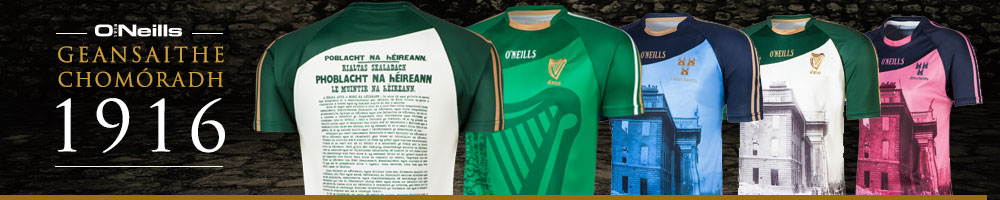
The Irish language edition of our 1916 Commemoration jersey marks the significant contribution that Irish language played in forming the opinions in Ireland in the early years of the twentieth century.
The Irish edition 1916 Commemoration jersey is developed in conjunction with Conradh na Gaeilge. This edition of the jersey featuring the Proclamation 'as Gaeilge' commemorates the role of the Irish language and the contribution of the Gaelic League/Conradh na Gaeilge in the events of 1916.
Of the sixteen leaders executed the majority were members of the Gaelic League. Ceannt, Clarke, Mac Diarmada, MacDonagh. O’Hanrahan, Pádraig Pearse, Willie Pearse, Casement, Heuston, Colbert, Daly and Kent were all members of the Gaelic League.
It was one of the key organizations in driving the radical ideas for reinventing and re-energising Irish society in the period building up to 1916.
The Gaelic League, or Conradh na Gaeilge, was founded in Dublin on July 31, 1893 by Douglas Hyde (Dubhghlas de HÍde in Irish), a Protestant from Frenchpark, County Roscommon with the aid of Eugene O'Growney, Eoin MacNeill, Luke K. Walsh and others.
The league developed from Ulick Bourke's earlier Gaelic Union and became the leading institution promoting the Gaelic Revival. The league's first newspaper was An Claidheamh Soluis (which translates as "the sword of light") and its most noted editor was Pádraig Pearse.
Though apolitical, the league attracted many Irish nationalists of different persuasions, much like the Gaelic Athletic Association. It was through the League that many future political leaders and rebels first met, laying the foundation for groups such as the Irish Volunteers (1913).
However, the League did not commit itself entirely to the national movement until 1915, causing the resignation of Douglas Hyde, future President of Ireland, who felt that the culture of language should be above politics.
Acknowledgements:
In conjunction with Conradh na Gaeilge.
I gcomhar le Conradh na Gaeilge